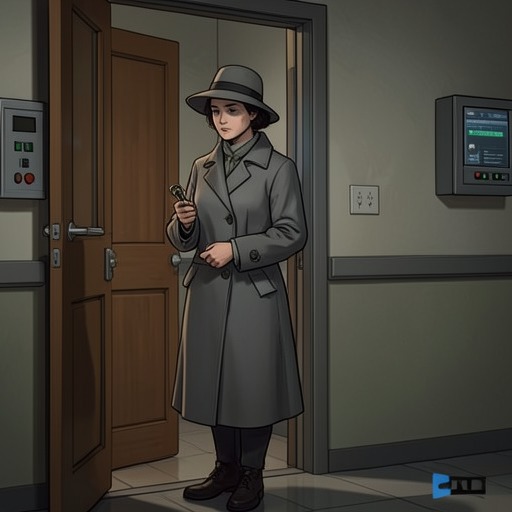
Alice Gould
Los renglones torcidos de DiosAlice Gould is the novel’s unstable point of contact between detective story and psychiatric case: she enters a hospital believing she has come to investigate a crime, yet the explanation she gives for her admission is false even as the harm concealed by that explanation proves real. The tension is not simply between sanity and illness. It lies between what Alice knows, what she believes, what she chooses to hide, and what the institution’s paperwork declares about her.
Identity and Admission
At the outset, Alice’s delusion casts her as a private investigator in charge of a team of detectives pursuing difficult cases. She presents herself not as a researcher but as a qualified detective, giving her imagined professional identity the firmness of a vocation rather than the air of a passing fancy. That identity supplies a coherent purpose for being inside the hospital: she thinks she has entered in order to investigate a crime.
Her admission, however, has an official paper trail. The application is signed by her husband, Heliodoro Almenara, as her nearest relative; a medical report recommends confinement; and a provincial authority grants her a place. The director later distinguishes this from voluntary admission, which would have required Alice’s own signed declaration and a certificate from Teodoro Ruipérez. The contrast makes the documents more than background procedure: they determine who can describe Alice’s condition and authorize her confinement. The orderly form of the paperwork sits uneasily beside her self-understanding as an investigator freely pursuing a case.
The hospital’s authority also reaches the ordinary details of her arrival. Staff treat her as a newly admitted resident, and the evidence includes a count of her clothes. In another moment, Alice takes cigarettes and a white-gold lighter from her handbag. Such small possessions sharpen the difference between the person arriving with a private life and the resident being processed by the institution. The record can inventory what she carries; it cannot, by itself, settle whether her account is illness, strategy, or both.
The Detective Identity and the Crime
Alice’s detective persona is not just a disguise laid over a single objective. It organizes how she interprets her surroundings and gives her a role from which to question the circumstances of her confinement. Samuel Alvar is her accomplice in this undertaking and, at one point, the only person said to know with certainty that she is entirely sane. That knowledge makes their partnership unusually consequential: the distinction between a patient’s delusion and an investigator’s cover story depends in part on what another person knows and is willing to acknowledge.
The novel later states that Alice’s explanation for entering the hospital is false: she believes she came to investigate a crime, and believes this firmly, but that belief does not make the stated reason true. Yet the case behind her conviction is not empty invention. María Luisa Fernández discovers that Heliodoro forged his wife’s signature and, taking advantage of her confinement, seized an inheritance that belonged to Alice. He has fled Spain by the time this information is presented. The revelation separates the truth of the fraud from the truth of Alice’s explanation: the injustice is real, but the account that has led Alice to imagine herself conducting an investigation is not a reliable account of her admission.
This split gives her detective identity its peculiar force. Alice can be wrong about why she is in the hospital while the world beyond its walls has genuinely wronged her. The plot therefore refuses an easy choice between a brilliant investigator whose suspicions are all vindicated and a patient whose claims can simply be dismissed. Her conviction is not proof of its own story, but neither does its falsity erase the concrete fraud that comes to light.
Diagnosis, Secrecy, and Institutional Judgment
The questions directed at Alice expose how much her case depends on distinguishing deception from delusion. Samuel Alvar asks how many times she has lied since entering the hospital. The question presumes a history of concealment, but it does not establish that every false statement has the same cause. Alice’s detective performance involves an adopted identity; the account of her admission, by contrast, is described as something she believes. The narrative keeps those conditions separate even as they become difficult to disentangle.
A later clinical account identifies Alice as a rare case in which paranoia has been provoked rather than arising spontaneously. That formulation changes the stakes of diagnosis. It does not simply endorse Alice’s original certainty that she entered to investigate a crime; the account expressly says that reason is false. Instead, it makes room for a history in which external circumstances have helped produce or intensify paranoid thinking. The hospital’s assessment thus bears on more than whether Alice can tell truth from falsehood: it asks how a person’s real circumstances may shape an account that is nevertheless delusional.
The difference between what Alice believes and what she can establish remains visible in her own words and silences. She gives an account of how everything began, identifies herself as Alice Gould de Almenara, and discusses the test she took. Later, she admits uncertainty to Montserrat Castell. After receiving news from Montserrat, she says she is still dazed by it, then shuts herself in her room and lies on the bed. These moments do not resolve the clinical question. They show instead a person trying to absorb revelations while other people and procedures continue to define what her reactions mean.
Allies, Exposure, and Confinement
Samuel Alvar’s role is marked by a striking asymmetry: he is Alice’s accomplice, and the one person described as certain of her sanity, yet his question about her lies places her credibility under scrutiny. The available evidence does not make that relationship a simple refuge. His knowledge gives Alice an ally inside the institution, but the demand to account for her lies shows how readily trust can become another examination.
Dr. Rosellini offers a different response to her confinement. He tells Alice how grave it would be for an internal physician to organize her escape and describes the treatment of her as a crime without mitigation. He and Alice spend much of an afternoon conspiring over an initial plan. His willingness to risk his position gives institutional dissent a concrete form: the question is no longer only what Alice claims, but whether a doctor inside the hospital believes the confinement itself has become indefensible.
Other relationships register the personal cost of the case without resolving it. Montserrat takes Alice by the arm and later brings news that leaves her stunned. César Arellano warns her, though the available account does not specify the warning’s content. Alice’s retreat to her room and her later admission that she does not know what to think mark a change of register: the self-assured detective can no longer turn every new fact into a clear investigative direction. Her uncertainty is part of the evidence of strain, not a final verdict on her condition.
Attachment and Narrative Significance
Alice’s concern for other residents supplies a counterweight to the institutional struggle over her identity. She wants to teach the small Rómulo a trade, hopes to reach the Niña Péndulo mind to mind and make her smile, visits Teresiña Carballeira’s embroidery workshop, and feels a kinship of aspiration with Cosme el Hortelano. She is grateful to Cosme and considers following his example by leaving all her property to the hospital. These are distinct forms of attention: practical care for Rómulo, an imagined channel of communication with the Niña Péndulo, interest in Teresiña’s work, and a shared ideal of giving up private wealth for the institution’s benefit.
Those attachments matter beside the inheritance story. Heliodoro’s appropriation of property makes ownership one of the real stakes hidden inside Alice’s supposed investigation; her thought of giving her own assets away, meanwhile, is presented as an aspiration rather than as proof that she has lost interest in the material world. Her relationships with the residents reveal a capacity to imagine futures for others even while her own future is being contested by doctors, documents, and the history of her marriage.
Alice’s narrative role rests on that unresolved doubleness. Her detective identity makes her a reader of clues, but she is also the central mystery whose testimony must be interpreted. The forged signature and stolen inheritance show that the world has supplied genuine grounds for injury; the false account of her admission and the description of provoked paranoia prevent those grounds from validating every belief she holds. Neither the paperwork nor Alice’s conviction alone can contain the whole truth. The novel makes that conflict the substance of her character: she is at once investigator, subject of investigation, and a person whose real losses can be obscured by the very story through which she tries to understand them.